Case 1: 45-45-90 Right Triangle
A 45-45-90 right triangle is a special type of triangle where two angles are 45 degrees and one is a right angle (90 degrees). Because the two 45-degree angles are the same, the two legs opposite them are also the same length. The hypotenuse in this triangle is √2 times the length of each leg. You can prove this relationship using the Pythagorean Theorem.
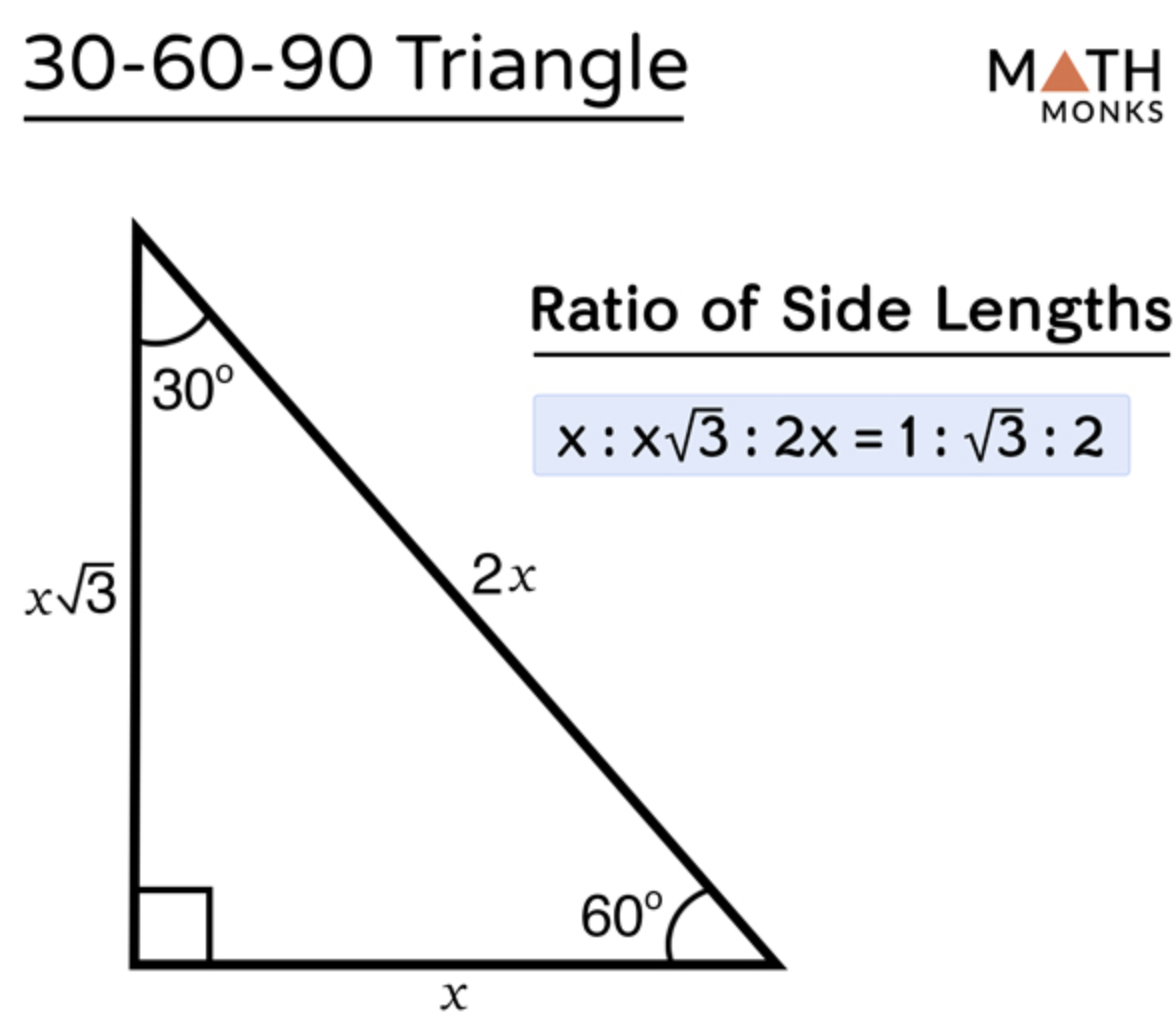
Case 2: 30-60-90 Right Triangle
A 30-60-90 right triangle has angle measures of 30°, 60°, and 90°. This creates a predictable ratio between the sides:
- The side opposite the 30° angle is the shortest and has length x.
- The side opposite the 60° angle is x√3.
- The hypotenuse (opposite the 90° angle) is 2x.
This ratio makes it easier to solve for unknown sides without needing trigonometry! A helpful trick is to remember that the bigger the angle, the longer the side. Since √3 is about 1.7, it makes sense that x√3 is longer than x but shorter than 2x.
Why Does This Matter?
Special case right triangles are incredibly useful in geometry. If you recognize one, you can calculate the other two sides of the triangle just by knowing one side — no sine, cosine, or tangent needed!
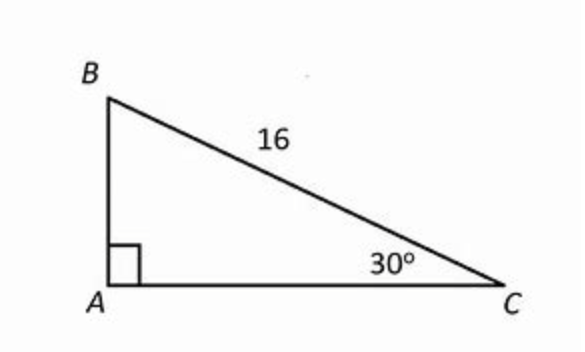
Example: If you have a 30-60-90 triangle and the hypotenuse (the side across from the 90° angle) is 16 units long, then:
- That corresponds to 2x = 16, so x = 8.
- The side opposite the 60° angle is 8√3 units long.
Test Your Knowledge
Click on the buttons below to try out interactive questions based on the content you've learned: