Translations (aka Shifts)
When you translate a shape, you are basically moving the entire shape in one direction (up, down, left, or right).
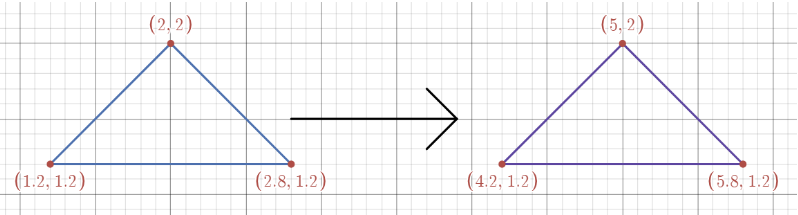
Example: By shifting the blue triangle to the right, you get the purple triangle. None of the angles or lengths of the sides changed—the entire shape was just moved to the right, and only the (x,y) coordinates changed.
By looking at the change in the (x,y) coordinates, we can figure out how big the translation was. If we focus on the top corner of the triangle, we can see that it starts at (2,2) and ends at (5,2). 5-2 = 3, so we can say the triangle was translated 3 units to the right.
Reflections
Reflecting a shape is like turning a piece of paper over or flipping a pancake. The shape doesn't change, but its orientation/position does.
When you reflect a shape, pretend there is an imaginary line you are flipping the shape over.
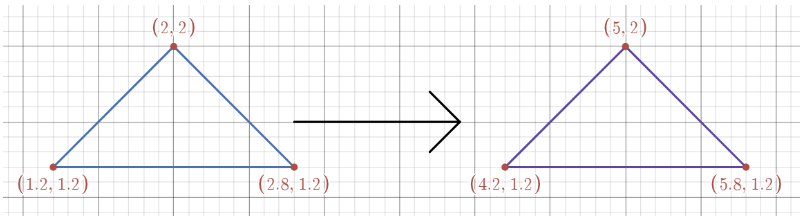
Example: If you reflect the blue triangle over the line x = 3, you get the purple triangle.
Rotations
To rotate a shape, you just turn it.
Example: If you rotate the blue triangle 90 degrees counterclockwise, you get the purple triangle.
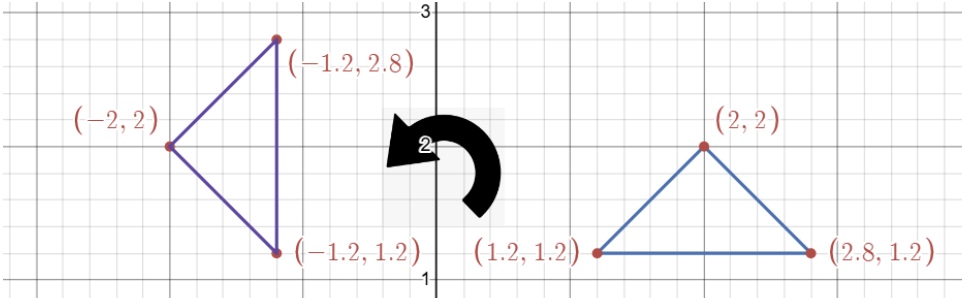
Notice that the numbers of the coordinates stay the same, but their position and sign changes:
- (2, 2) becomes (-2, 2)
- (1.2, 1.2) becomes (-1.2, -1.2)
- (2.8, 1.2) becomes (-1.2, 2.8)
This is because the general pattern for rotating a point 90 degrees clockwise is: (x, y) → (-y, x)
The chart below shows the patterns for all types of rotations:
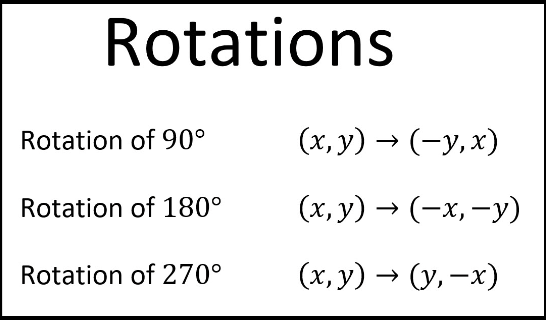
I like to visualize these instead of memorizing the formulas, but do whatever works for you!
Example: If I think about turning something 180 degrees, it makes sense that the x and y would be the same but become negative.
Try It Yourself: Interactive Graphing Tool
Use this Desmos-powered graphing calculator to explore translations, reflections, rotations, or any other functions. Try inputting things like f(x) = (x-3)^2 to see a horizontal translation!
Test Your Knowledge
Click on the buttons below to try out interactive questions based on the content you've learned: