Summary
The division of a polynomial of degree 2 or a polynomial of degree 1 by a polynomial of degree 1 (assuming the degree of the divisor does not exceed the degree of the dividend).
Reminder: The degree of a polynomial is the highest exponent of the variable.
Examples of Polynomials
First Degree Polynomial Examples: x-2, x+27
Second Degree Polynomial Examples: 4x² + 3x + 6, x² - 23
Steps for Dividing Polynomials Using Long Division
Step 1: Set up the division problem
Set up the division problem just like you would with regular numbers.

Step 2: Divide the first term of the dividend by the first term of the divisor
Take the first term of the dividend and divide it by the first term of the divisor.

Step 3: Multiply the divisor by the term you just found
Multiply the divisor by the term you just found in Step 2.
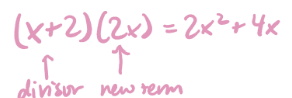
Step 4: Subtract the result from the dividend
Subtract the result from the dividend to get a new polynomial.

Step 5: Repeat the process with the new polynomial
Repeat the same steps with the new polynomial until you can't divide anymore.
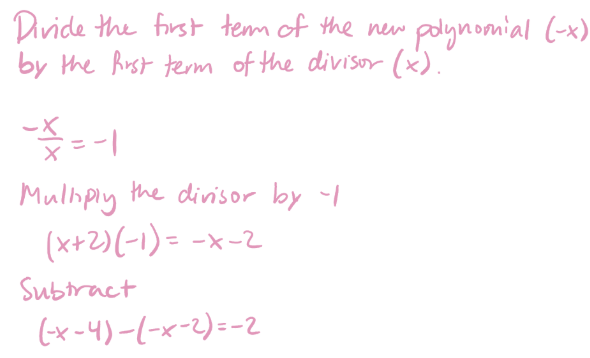
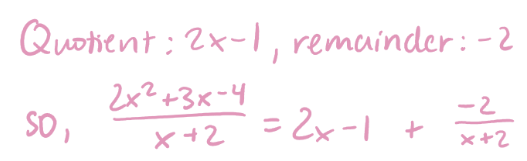
Step 6: Write the final result and remainder as a fraction over the divisor
The final result is written as the quotient, and the remainder is placed over the divisor as a fraction.
Tip: Always align terms by their degrees when setting up the division.
Test Your Knowledge
Click on the buttons below to try out interactive questions based on the content you've learned: